
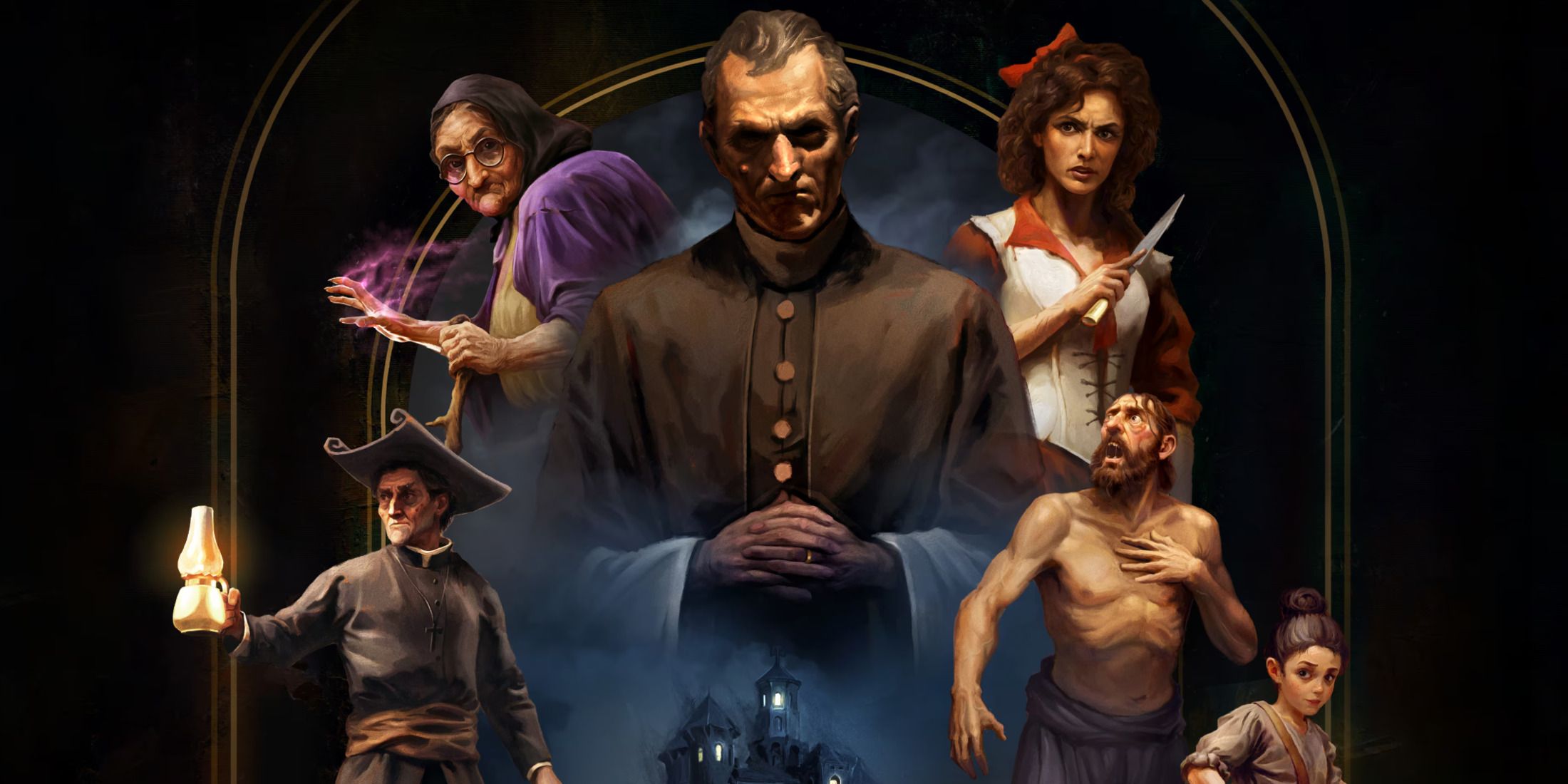
As far as real-time tactical stealth games go, The Stone of Madness is an artistically singular entity, unique in style but faithful to the mechanics players may expect to find in the genre. Set in an 18th-century Spanish Jesuit Monastery in the Pyrenees, players find themselves both in a house of the Lord and an asylum for those with mental problems. But not everything is as it seems, and while searching for a way to escape, the truth behind the strange structure and its less-than-holy inhabitants begins to come to light.
Blending the use of puzzles and mechanics found in horror games of the past with an art style inspired by famed 18th-century Spanish painters and modern cartoonists, trying to pin down The Stone of Madness isn’t easy. Its religious themes and setting are quickly memorable, as are its character designs and its inclusion of a sanity meter, though certain aspects of its gameplay and story left me feeling incomplete and hungry for more.
The developers at The Game Kitchen excel at creating dark titles overflowing with religious iconography, with the 2019 Metroidvania title Blasphemous and its 2023 sequel Blasphemous 2 finding acclaim for their visual style and combat. Players control a character dubbed the Penitent One in these games, while in The Stone of Madness, they begin as Alfredo, a devoted priest imprisoned by a corrupt Inquisitor eager to discover what lurks within the confines of his sudden prison.
The Stone of Madness Boasts an Incredibly Unique Art Style
It’s estimated that over 15,000 video games were released in 2024. With more and more creators throwing their hat into the proverbial ring each year, creating a title that stands out is key - and it would be difficult to argue that The Stone of Madness fails to do so. Its cinematic scenes are polished and smooth, the monastery setting is detailed with a tinge of realism, and its characters are far from cookie-cutter.
These are not the youthful and peppy protagonists one might expect to find in a modern title. Agnes is a hunched-over old woman who gives the impression that she has seen too much, while Eduardo is a middle-aged man rendered mute by his torture within the asylum’s walls. As players progress, they will eventually find themselves in a party of five eager escapees, all of whom bring their own skills, upgradable abilities, and phobias to the group. The latter is particularly important, and where The Stone of Madness shines, as fear can be more damaging than any prison guard could hope to be. Frustratingly, most of the game’s interactions between characters lack voice acting. While this isn’t a massive issue, it may have given certain moments more dramatic flare and punctuation.
Leonora is the only member of the party able to harm guards directly, but she is terrified of fire, something very common throughout the monastery as its primary light source. If there is a fire near her target, she is unable to attack, and her sanity slowly begins to trickle away if she stays near the flames for too long. Amelia, a young pickpocket, is similarly terrified of gargoyles, while Alfredo fears dead bodies and Eduardo is afraid of the dark. Trying to avoid the character’s fears while also attempting to sneak past guards and solve increasingly intricate puzzles is a tough balancing act, but that’s certainly what The Stone of Madness is going for. Later in the game, I sometimes felt as if I were beginning to go mad myself.


0 Comments